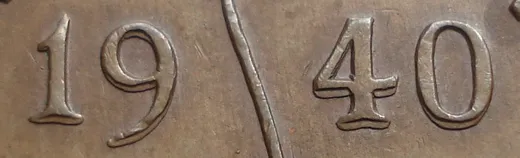
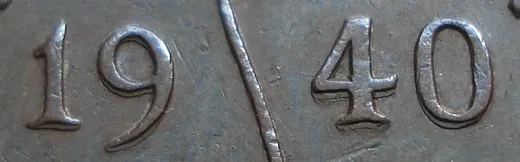
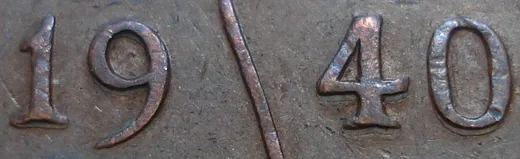
1940 Newfoundland One Cent
George VI · 7 varieties · study revised Apr. 9th 2015
In 1940, the Canadian Royal Mint began the final production of coins for Newfoundland. This would continue right up until 1947 when the last coins were minted for the colony which, in 1949, would become the tenth province to join Canada.
Read Barry's full introduction
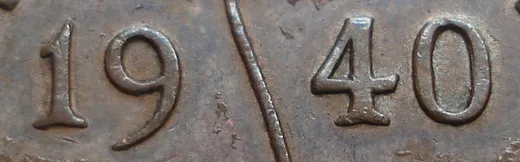
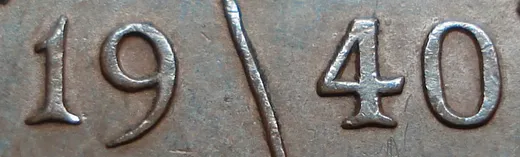
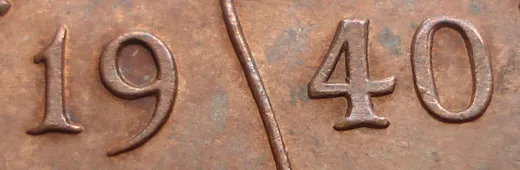
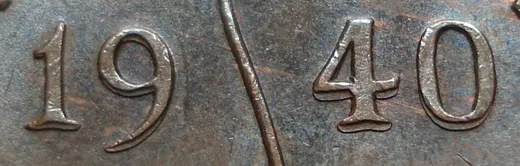
The coins issued for this date, can be grouped into both Narrow and Wide Date varieties, however, there is also a family of Repunched/Re-engraved variations which makes this a very complex year! It appears that there is a general consensus among both collectors and dealers alike, that these Re-engraved varieties all originated from a single die! This general opinion, seems to suggest that these different effects were caused possibly by a loose die collar or because of the continuous wear to the die. However, the evidence would suggest another possibility. When many of these Re-engraved coins were studied, it was found that there were often subtle, but obvious differences between them. There were so many variations within the specific Letters and Numbers, that it seemed virtually impossible for them to have originated from a single Die! The implication here is that several dies were used for these coins! They were most likely created from previously used dies which had been Modified in order to extend their production lives. By doing this, the Mint could use these refurbished dies to complete quotas or possibly to fill smaller orders. This would seem to explain why there are so many differences and why these coins are so scarce! Hans Zoell, in his 1962 Catalogue, made reference to both the 1940 double date Cent and the 10 Cent coins. His explanation was that this effect was caused by the die re-entry. However, if this was the case, then it would be expected that all of the "Shadows" would be identical to their related numerals but some are not. In some instances, these Shadows were longer, thicker and had different shapes than those of the digits they were mirroring! Finally, it would seem to be too much of a coincidence, that these very same "errors" would also appear on the 1941 coinage!