1890 Newfoundland 20 Cents
Victoria · 5 varieties · study revised Mar. 7th 2013
Mintage 100,000Royal Mint, LondonSterling silver
Portrait 1 or Portrait 2? How to tell Queen Victoria's two portraits apart.
Both the 1890 and 1894 coinage play an important role in the development of the 20 Cent series. It was during these two years when the dies were extensively modified, which effectively corrected some of the more obvious problems that had previously occurred. As a result of these changes, the mint produced some of its strongest strikes of the entire Victoria 20 Cents series!
Read Barry's full introduction
During the previous ten year period, in which coins were minted, it appears that very little had been done to modify any of these dies. Only the 1888 issue showed any significant signs of having been modified. In order to find a comparable period, you would have to look back to the previous decade (of the 1870's), to find anything that would even slightly resemble the changes that were made during these latter two years. However, in this case, it would be quite understandable because the 20 Cent series was still relatively new back in the 1870's and these first few years would be needed to iron out some of the more problematic bugs that have occurred.
In 1890, the mint went back to its production of Newfoundland coins but apparently, this time they felt that they had to modify their existing dies in order to improve upon the quality of the coins. As a result of these changes, a number of interesting varieties have occurred for this year. At this moment, there are no fewer than four different known variations and it is almost certain that others are still waiting to be discovered!
Finally, each of these varieties display differences to the size of the Gaps separating the last three numbers in their respective dates. In some cases, these variations are quite noticeable and are helpful in the recognition of a particular variety. Also, it is important to take notice of the significant modifications made to the letter C (in the word CENTS) and to the 2 (of the 20). Initially they all appear to be quite similar but when they are more closely examined, it can be seen that there are subtle differences, which are unique to each of them!
The varieties
TYPE I
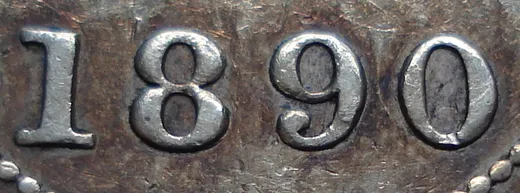
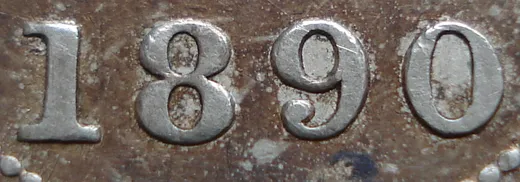
TYPE II
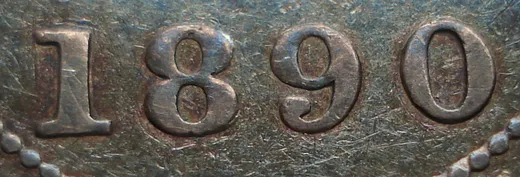
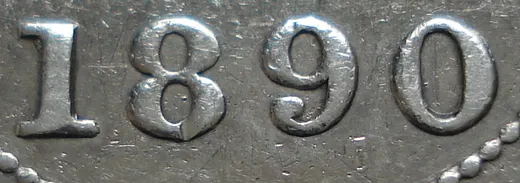
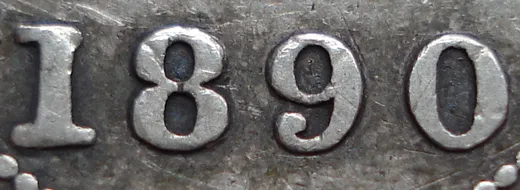
Compare two varieties
The same view of each variety, lined up so the shared design matches. Drag the divider to see what moves.
Not lined up: Barry framed these photos differently, so one is simply laid over the other at its own proportions. Compare the details by eye rather than by what moves.
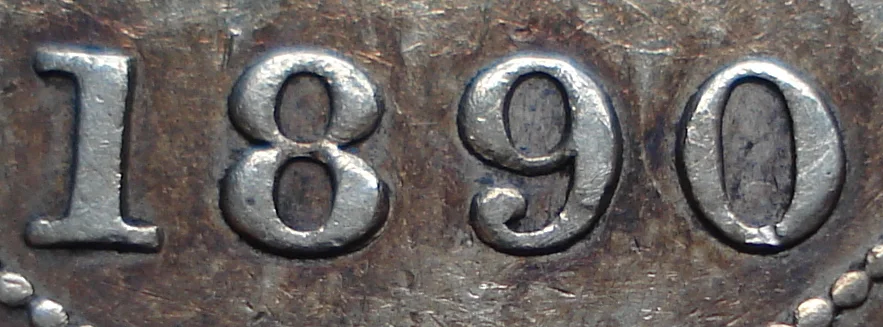
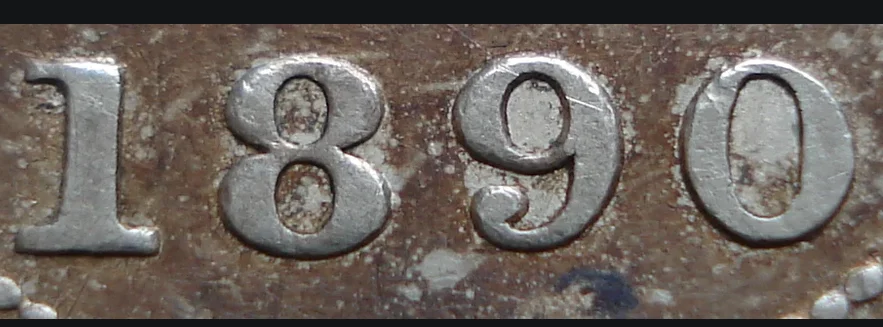
Population report
How many of each variety Barry found among the 1890 coins he examined, and what that projects for the whole mintage. From his report of December 2019. Lines that match a variety on this site link to it. How the reports work.
| Variety | Coins | Share | Projected |
|---|---|---|---|
TYPE I (a) ND, Re-Engraved 2 & C |
159 | 60.2% | 60,228 |
TYPE I (b) ND, Re-Engraved 2, C & S |
69 | 26.1% | 26,136 |
TYPE II (a) Wide Date, Far 0 |
32 | 12.1% | 12,121 |
TYPE II (b) WD, Re-Engraved 0, C & S |
4 | 1.5% | 1,515 |
| Total | 264 | 100% | 100,000 |
Cite this page
Borsellino, Barry M. “1890 Newfoundland 20 Cents varieties.” Newfoundland Coin Varieties, https://www.nfldcurrency.ca/twenty-cents/1890/.
Text and photographs © Barry M. Borsellino, shared under CC BY-NC 4.0.
